Vimeo built its reputation on beautiful ad-free video hosting, and on that front it is still one of the best in the business. Live streaming is a different story. Over the past few years Vimeo has restructured its plans several times, and live features have moved steadily up the pricing ladder. In the current lineup, full live streaming and webinar capability effectively starts at the Advanced tier (around $75/mo billed annually, and noticeably more month to month), with the most serious live workflows pushed to custom Enterprise contracts. Add the late-2025 acquisition by Bending Spoons and the uncertainty that followed, and a lot of live-first users are re-evaluating.
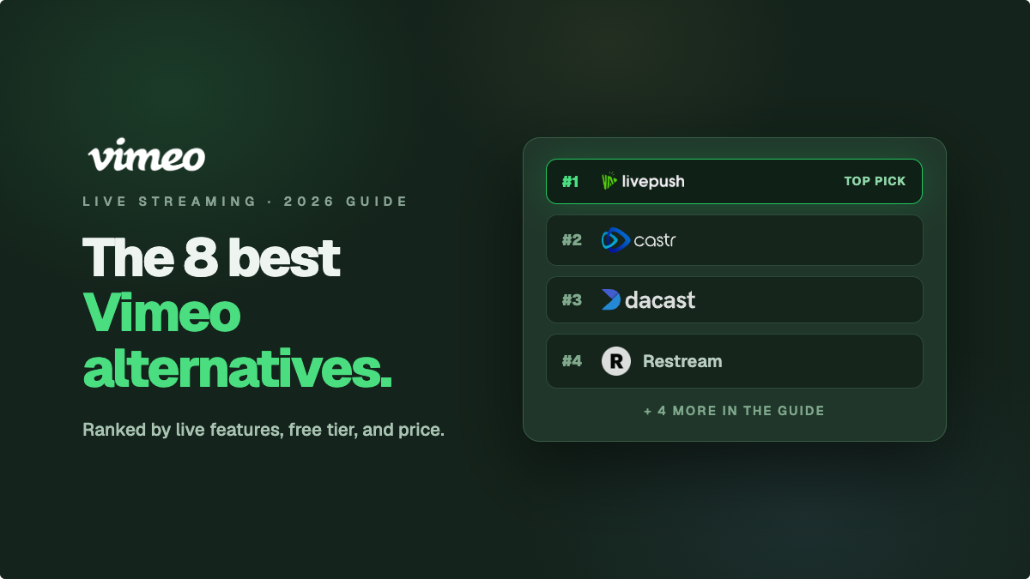
This guide covers 8 credible Vimeo alternatives for live streaming in 2026. We have kept it honest: each entry has a clear "best for" line with real pros and cons, and Livepush (the platform behind this blog) is listed as one option among several, not automatically crowned the winner. Livepush is strong for live, multistreaming, and event hosting, but it is not a full Vimeo replacement if what you mainly need is a polished home for a large VOD portfolio. Pricing changes often, so treat every figure below (current as of October 2026) as an approximate entry point and confirm on each vendor's site before you buy.
Why People Leave Vimeo for Live Streaming
Three complaints come up again and again, and none of them is about video quality.
Price. Vimeo's hosting tiers are reasonable (Starter around $12/mo and Standard around $25/mo per seat on annual billing, more month to month), but those plans are built around VOD. Once you need real live streaming, you are looking at Advanced at roughly $75/mo billed annually, or a custom Enterprise quote. Dedicated live platforms deliver the same core job, ingest, transcode, player, distribution, for a fraction of that.
Live features are gated. Simulcasting to social platforms, webinar tooling, registration, and stream recording all sit on the higher tiers. If you stream weekly but only need basic hosting otherwise, you end up paying for an expensive plan to unlock one workflow.
Event and stream limits. Even on live-capable plans, Vimeo caps things like concurrent streams and webinar registrants (the Advanced tier is commonly cited at 2 concurrent streams and around 100 webinar registrants). Organizations that run frequent or parallel events hit those walls quickly, and the answer is usually "talk to sales."
None of this makes Vimeo a bad product. It makes it a VOD-first product whose live streaming has moved upmarket. If live is your main event rather than an add-on, the platforms below are built for exactly that.
Quick Comparison of Vimeo Alternatives
| Platform | Best for | Live features | Free tier | Entry price |
|---|---|---|---|---|
| Livepush | Live, multistreaming, and event hosting | 40+ destinations, pre-recorded live, 24/7 channels, HLS player | Yes (3 dest, 20 hrs/mo) | ~$15/mo |
| Dacast | Professional live plus VOD in one account | RTMP/SRT ingest, paywall, white-label player | Trial only (14 days) | ~$39/mo (annual) |
| IBM Video Streaming | Enterprise-grade live with strict reliability needs | Large-scale delivery, AI captions, security controls | Trial only (30 days) | ~$154/mo |
| Brightcove | Large media and marketing video operations | Live plus mature VOD, analytics, integrations | Demo only | Custom quote |
| Uscreen | Creators monetizing VOD and live memberships | Live streaming inside a paid membership site | Trial only (14 days) | ~$49/mo (Starter), ~$149/mo plus per-subscriber fees (Growth) |
| StreamYard | Browser-based live production with guests | Cloud studio, overlays, simulcast to 3 or 8 destinations by plan | Yes (1 dest, watermark) | ~$36/mo annual (~$45/mo monthly) |
| Restream | Pure multistreaming to social platforms | 30+ destinations, studio, unified chat | Yes (2 dest, branding) | ~$19/mo |
| YouTube Live | Free public streaming with maximum reach | Free ingest, DVR, huge audience | Yes (fully free) | Free |
Streaming vendors reprice and repackage constantly, and Vimeo itself is the proof. Every figure here is an approximate entry point, usually the annual-billing rate, and live features are often gated to specific tiers. Confirm current pricing and per-plan limits on each provider's own site before committing.
The 8 Best Vimeo Alternatives
1. Livepush
Livepush is a live-first platform built around multistreaming, pre-recorded live, 24/7 looping channels, and live event hosting on an Akamai-backed CDN with an embeddable HLS player. Where Vimeo gates simulcasting and live tooling to its Advanced tier, Livepush includes multistreaming to 40+ destinations from its low-cost plans, and its free tier allows 3 simultaneous destinations and 20 hours per month. For branded events, the Event Hosting plan (around $49/mo) adds access control and paywall features at a price well below Vimeo's live-capable tiers. To be clear about the honest trade-off: Livepush is not trying to be a full Vimeo replacement for hosting a large, portfolio-style VOD library.
Best for: Live-first creators, churches, and event teams that want multistreaming, scheduled pre-recorded broadcasts, and an embeddable player without enterprise pricing.
Pros: Generous free plan, 40+ destinations, pre-recorded and 24/7 live, hosted HLS player, RTMP and SRT ingest, affordable event hosting with paywall options.
Cons: No browser studio (bring your own encoder such as OBS), and VOD hosting is functional rather than portfolio-grade. See the dedicated Vimeo alternative comparison or the Livepush multistreaming feature page for details.
2. Dacast
Dacast is probably the most direct like-for-like Vimeo replacement on this list because it pairs professional live streaming with real VOD hosting in one account. You get RTMP and SRT ingest, a white-label player, paywall and monetization options, and Akamai-tier CDN delivery, starting at around $39/mo billed annually (2.4 TB of bandwidth per year). That is roughly half the entry point of Vimeo's live-capable Advanced plan, and live streaming is included from the bottom tier rather than gated upmarket.
Best for: Businesses and broadcasters that need both live streaming and a hosted VOD library with monetization.
Pros: Live plus VOD in one platform, paywall support, white-label player, professional CDN, no live gating on entry plans.
Cons: No free tier (14-day trial only), bandwidth-based pricing needs watching for large audiences, the paywall is an add-on below the $63/mo Event plan, and social simulcasting is metered by hours per plan rather than unlimited.
3. IBM Video Streaming
IBM Video Streaming (formerly Ustream) is the conservative enterprise choice, and it is aimed at the same buyers Vimeo Enterprise courts: corporations, universities, and organizations that need reliable large-scale delivery with security controls, AI-powered captioning, and detailed analytics. Entry pricing is around $154/mo for the Silver plan (100 viewer hours, 5 channels), with a 30-day trial, which sounds high next to creator tools but is competitive against Vimeo Enterprise quotes for comparable capability.
Best for: Enterprises and institutions running high-stakes internal or public broadcasts with compliance requirements.
Pros: Proven reliability at scale, strong security and access controls, automated captions, enterprise support.
Cons: Expensive for small teams, dated interface in places, and overkill for creators or occasional streamers.
4. Brightcove
Brightcove sits at the top of the online video market and is the platform many large media companies moved to when they outgrew Vimeo. It combines mature VOD management, live streaming, server-side ad insertion, deep analytics, and a large integration ecosystem. There is no public pricing; everything is a custom quote, and contracts are typically annual and substantial. If Vimeo Enterprise is on your shortlist, Brightcove belongs there too.
Best for: Large media, broadcast, and marketing teams that treat video as core infrastructure.
Pros: Best-in-class VOD plus live in one platform, monetization and ad tooling, enterprise reliability and support.
Cons: Custom pricing only, meaningful minimum spend, and far more platform than a creator or small business needs.
5. Uscreen
Uscreen approaches the problem from the monetization side. It is a membership platform where creators sell subscriptions to a branded video library, with live streaming built in so members can attend classes, premieres, and events. If your reason for using Vimeo was Vimeo OTT (selling access to your content), Uscreen is the specialist alternative, with a $49/mo Starter plan (capped at 100 subscribers, no per-subscriber fee) and the more typical Growth plan at $149/mo plus $1.99 per subscriber. It is an investment, but the monetization tooling (apps, communities, checkout) goes deeper than Vimeo's equivalent.
Best for: Fitness instructors, educators, and creators selling paid access to VOD libraries plus member-only live streams.
Pros: Purpose-built monetization, branded apps and website, live streaming included for members, strong community features.
Cons: Per-subscriber fees and a steep jump from the $49 Starter cap to the $149 Growth plan, not designed for free public streaming, and no meaningful free tier.
6. StreamYard
StreamYard is the pick if what you actually need is live production rather than video hosting. It is a browser-based studio: invite guests with a link, add overlays, banners, and brand colors, and simulcast to several platforms at once with no encoder required. It will not host your VOD library or give you an embeddable ad-free player the way Vimeo does, but for interview shows, webinars, and panels it is dramatically easier than Vimeo's production workflow, at around $36/mo billed annually ($44.99/mo monthly).
Best for: Podcasters, marketers, and creators running guest-based shows from a browser.
Pros: Easiest guest workflow in the category, clean browser studio, reliable simulcasting, free plan to test with.
Cons: Watermark and limits on the free plan, no real VOD hosting, and no 24/7 or pre-recorded channel workflow. We compare it with a pure multistreamer in Restream vs StreamYard.
7. Restream
Restream is the best-known name in cloud multistreaming, and it replaces one specific Vimeo feature very well: simulcasting. Where Vimeo's simulcast is a checkbox on an expensive tier, Restream is built entirely around fanning one stream out to 30+ destinations, with a browser studio and unified cross-platform chat on top. It is not a video host, so pair it with wherever your VOD lives. Paid plans start around $19/mo, and the free plan allows two destinations with Restream branding.
Best for: Creators whose main goal is reaching multiple social platforms simultaneously.
Pros: Mature, reliable simulcasting, unified chat, large integration list, browser studio included.
Cons: Two-destination branded free plan, pricing climbs as you add destinations and features, and there is no hosting or embeddable ad-free player. If this category fits you, our best Restream alternatives guide compares the whole field.
8. YouTube Live
YouTube Live is the free default, and pretending otherwise would make this list dishonest. It costs nothing, scales to any audience size, offers DVR and automatic archiving, and gives you access to the largest video audience on earth. The trade-offs are real, though: ads and recommendations you do not control, platform branding on embeds, content policies that can interrupt a stream, and analytics that serve YouTube's goals as much as yours. It is a distribution channel, not owned infrastructure.
Best for: Anyone who wants free public streaming and maximum reach, and can live with platform rules and branding.
Pros: Completely free, unlimited scale, automatic VOD archiving, familiar to every viewer.
Cons: Ads and third-party recommendations, limited branding control, copyright and policy enforcement risk, no white-label experience. Many teams stream to YouTube and their own site at once; our guide to embedding a live stream on your website shows how to keep an owned front door.
Where Vimeo Still Wins
Fair is fair. If your primary need is hosting a professional, ad-free video portfolio with a beautiful player, granular privacy controls, and simple review workflows, Vimeo is still excellent, and none of the live-first tools above match it there. Its webinar product is polished, its player is arguably the best default embed in the industry, and Vimeo OTT remains a legitimate option for subscription video businesses that want everything under one roof. The case for leaving is specific: you stream regularly, live features are the thing you actually pay for, and the tier that unlocks them costs several times what a dedicated live platform charges.
How to Choose the Right Vimeo Alternative
Match the tool to your workload rather than the brand:
- Corporate events and town halls: IBM Video Streaming or Brightcove if you have enterprise budget and compliance needs; Dacast or Livepush's Event Hosting plan if you want professional delivery with access control at mid-market prices.
- Churches and community organizations: Livepush is a strong fit, since pre-recorded live, 24/7 channels, multistreaming to Facebook and YouTube, and an embeddable player cover the typical weekly workflow at low cost. YouTube Live works too if platform branding is acceptable.
- Monetized VOD plus live: Uscreen if memberships are the business model; Dacast if you prefer pay-per-view and rentals; Brightcove at enterprise scale.
- Simple multistreaming: Restream or Livepush for pure fan-out, StreamYard if you also want a guest studio. Our best multistreaming platforms roundup ranks that category in depth.
- Maximum reach at zero cost: YouTube Live, ideally embedded on your own site so you keep an owned destination.
When comparing against Vimeo, always compare the plan that actually includes your live features, not the headline starting price. Vimeo from $12/mo and Vimeo with real live streaming are very different products, and the same gating pattern exists on several alternatives too.
There is no single best Vimeo alternative because Vimeo bundles several products into one brand. If you are replacing the hosting, look at Dacast or Brightcove. If you are replacing the monetization, look at Uscreen. If you are replacing the live streaming, which is why most people land on this page, a live-first platform will almost always be cheaper and more flexible: Livepush for multistreaming, pre-recorded live, and event hosting, StreamYard for browser production, Restream for pure simulcast, and YouTube Live when free trumps everything else. Shortlist two, run one real stream through each, and compare against the Livepush pricing page to see what your current Vimeo spend would buy on a dedicated live platform.
See for yourself: free for 20 hours/month
Create a free account. No credit card needed. 3 destinations included.