In China, live stream shopping is not a trend; it's the store. Around 60% of ecommerce there flows through live selling, by ARK Invest's estimate; the US number is closer to 5%, and that gap is exactly why the format is worth your attention: US live commerce hit roughly $14.6 billion in 2025, growing near 50% a year, according to eMarketer's research. Formats that jump markets rarely jump backward.
But set the market-size talk aside, because the practical case is simpler: Firework, a live commerce vendor, puts live shopping conversion between 9% and 30%, against 2 to 3% for standard ecommerce pages. Treat the top of that range as a vendor figure, but even the bottom of it is triple a normal product page. This article explains where that gap comes from, who's winning with the format in 2026, and how to run your first show without a studio.
Why a Live Video Sells Better Than a Product Page
A product page is a monologue. A live show is a conversation, and three mechanisms in that conversation do the selling.
Demonstration beats description. Watching a jacket move on a person, a pan sear an actual steak, or a phone case survive an actual drop resolves the doubts a gallery of photos can't. This is the old genius of TV shopping channels, and it never stopped working; it just moved.
Questions get answered before they become abandoned carts. "Does it run small?" asked in chat and answered in seconds is a sale. The same question unanswered on a product page is a closed tab. The host is doing live objection-handling for hundreds of people at once.
Scarcity is credible when it's live. "50 units at this price while the stream is up" lands differently than a countdown timer on a website, because everyone can see the same moment happening. Used honestly, that urgency converts fence-sitters; used dishonestly, it torches the trust the whole format runs on.
The numbers back the mechanics. Pop Mart drives about 85% of its TikTok Shop revenue from livestreams. Skincare brand goPure ran 483 hours of live shows and cleared $1 million from them. The format rewards reps: these are brands that treat live selling as a schedule, not a stunt.
The 2026 Platform Map
| Platform | Best for | The catch |
|---|---|---|
| TikTok Shop LIVE | Impulse-friendly products, discovery of new buyers | Fees, policy churn, and the algorithm owns your reach |
| Whatnot | Collectibles, cards, sneakers, resale auctions | Auction culture; wrong fit for most standard retail |
| Amazon Live | Shoppers already in buying mode | Discovery is weak unless you bring the audience |
| YouTube (shopping features) | Long demos, established channels | Slower burn; works best with an existing subscriber base |
| Facebook Live | Older demographics, local and community selling | Native shopping tools have been pared back; often paired with comment-to-order workflows |
| Your own website | Margin and customer ownership | You bring 100% of the audience |
Two notes on reading this table. First, TikTok Shop is the current center of gravity (nearly a fifth of US social commerce, with about half of US TikTok users having bought through it), but its livestream share is drifting as the platform pushes shoppable short videos too, and platform dependence is a real business risk; QVC picked up over 100,000 customers from TikTok Shop in a single quarter, which tells you audiences move. Second, the last row is not a consolation prize. Marketplace fees are real, and the buyer data on your own site is worth more than the first sale.
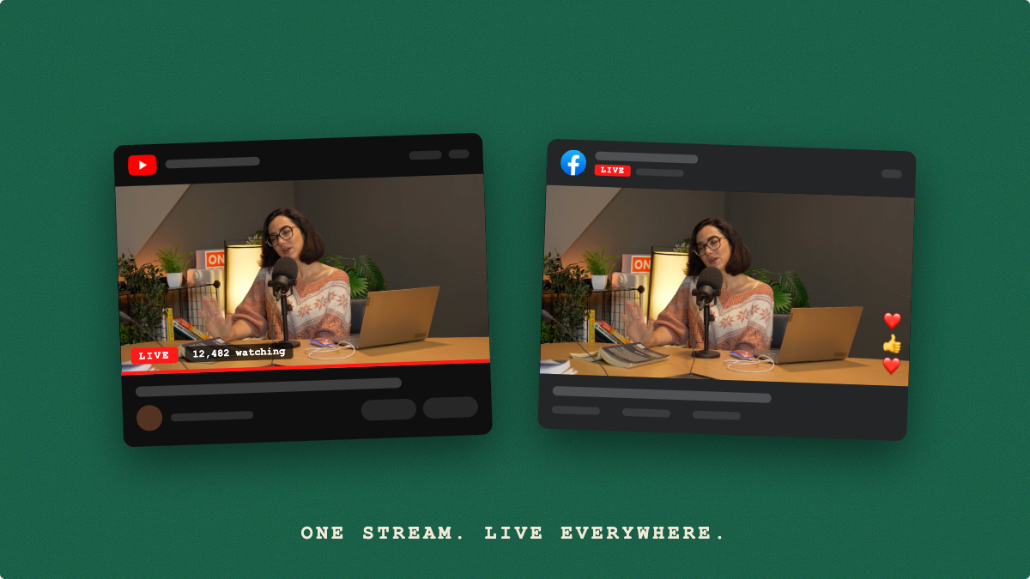
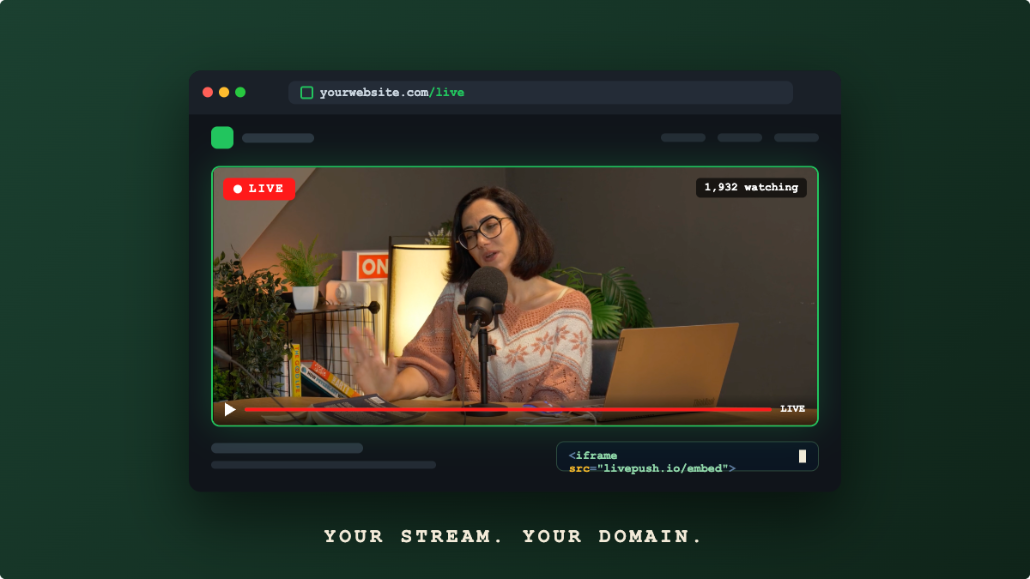
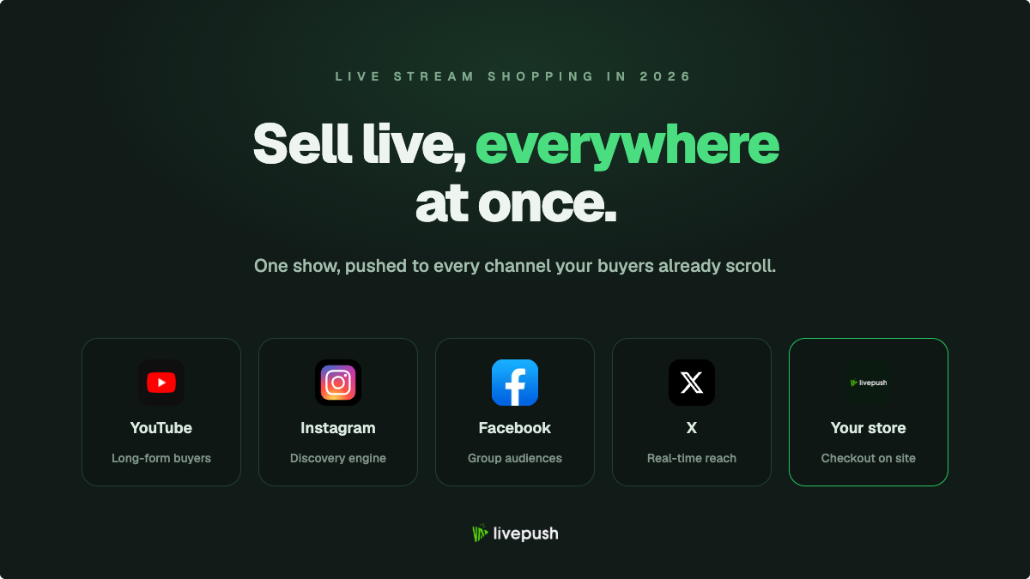
Which is why the sensible architecture for a growing seller is most of the table at once: one live show, multistreamed to TikTok, YouTube, Facebook, and an embedded player on your own site simultaneously. With Livepush you broadcast once and the platform forwards the stream everywhere, with every platform's chat in one view so the host can answer a question from TikTok and a question from your website in the same breath. Each marketplace handles its own checkout; your site handles yours.
The Four Show Formats That Work
Live selling is not one format, and picking the right shape for your product matters more than production polish.
The demo show. The QVC classic: one product category, demonstrated thoroughly, with the host answering questions and repeating the offer. Best for products with a "seeing is believing" quality: cookware, beauty, gadgets, apparel on a real body. This is the default format, and the right first one for most brands.
The drop. A scheduled release of limited inventory (new colorway, restock, collab) where the stream is the only or earliest place to buy. The stream itself is part countdown, part party. Works when you already have an audience that wants the thing; it converts existing demand rather than creating it.
The auction. Whatnot's native format, dominant in cards, collectibles, and resale: rapid-fire lots, real-time bidding, dozens of transactions per hour. Electric for the right inventory, but it's a skill (auctioneering, genuinely) and wrong for fixed-price retail.
The shopping hangout. A recurring, looser show where the host tries arrivals, reacts to trends, and sells whatever comes up, closer to streaming culture than retail. Slowest to convert, best at building the parasocial trust that makes the other three formats convert later.
Most sustainable live-selling operations settle into a weekly demo or hangout with occasional drops layered on top.
Running Your First Show: A Realistic Playbook
Pick one hero product and two supporting ones. First shows die from catalogs. One product you can demonstrate for ten straight minutes, with an entry-price item and an upsell around it, is a show.
Write a loop, not a script. Live shopping audiences churn constantly; the viewer count is not one crowd but a river. Structure the show as a 10-15 minute loop (hook, demo, offer, Q&A) you repeat with variations, so someone arriving at minute 43 gets the pitch within a few minutes. Ignore the urge to say "as I said earlier"; for most viewers, you didn't.
Staff the chat. The host should read and answer chat constantly by name; it's the whole difference from television. Past a few dozen concurrent viewers, add a second person just for chat: pinning answers, dropping links, flagging good questions to the host.
Make the offer stream-specific and honest. A code that only works during the live show gives viewers a reason to buy now and a reason to come back for the next one.
Schedule the next show before ending this one. Live selling compounds weekly. The audiences that convert at the top of that 9-30% range are the ones who show up on purpose, and they can only do that if there's a schedule.
On gear: start with a phone, a tripod, bright even lighting, and a clip-on mic; upgrade to OBS on a laptop when you want price overlays and multi-platform output (our TikTok live guide and multi-platform streaming guide cover both stages). A stable connection matters more than a better camera: a frozen stream during a flash offer is money evaporating in real time, so check the bandwidth guide before your first show, not after it.
The Numbers to Watch After Each Show
Viewer count is the vanity metric here; sales per viewer-minute is the business. After each show, look at five things: total sales (obviously), conversion rate (buyers divided by unique viewers; live shopping's benchmark range is that 9-30% spread, and your early shows will start below it), average order value (bundles and live-only upsells move this), peak concurrent viewers and when they happened (so you learn which segments of your loop hold a room), and returning viewer share (the number that predicts whether show ten will outsell show one). Streaming platforms and shop dashboards each hold half this picture, so keep a simple spreadsheet per show; trend lines across five shows will teach you more than any article, including this one.
The Honest Caveats
Live shopping is not free money. About 43% of US adults report no interest in the format, and most US buyers still haven't tried it; you are fishing in a growing pond, not an ocean. Conversion claims at the "30%" end belong to skilled hosts with warm audiences and giveaway-priced offers, not to a first stream. And the format is labor: an hour live plus prep, every week, indefinitely. The sellers winning at this treat it like a storefront's opening hours, not a marketing campaign.
But the direction of travel is hard to argue with. The infrastructure is commodity now, the buyer behavior is normalizing a year at a time, and the conversion mechanics (demonstration, live answers, credible urgency) are as old as markets. The sellers building the habit, the audience, and the weekly rhythm in 2026 are the ones who'll own the format locally when it stops being novel. Go live once with one product, and you'll be ahead of most of your competitors, who are still reading articles like this one.
Start streaming free today
Livepush is free for 20 hours/month. No credit card required.